
Healthcare and financial services organizations face a distinct balancing act when incorporating gen AI tools into their customer support flows. On one hand, these tools promise to be revolutionary, providing faster and better solutions to customer issues. On the other hand, the public dislikes and distrusts gen AI. Firms need to balance introducing and implementing these tools while still assuring customers that they will not be misled by a hallucinating clanker.
There are some success stories, or stories claiming success. Fintech firm Dave claimed a 89% resolution rate with its initial gen AI driven chatbot. USAA rolled out an AI assistant for its 16,000 person customer service team, which has proved popular and successful—although the firm only uses this AI tool internally, with a human being always acting as an intermediary between AI and the customer.
Trust is of particular importance in healthcare, making the implementation of gen AI even trickier for health plan organizations.
In a recent Health Plan Monitor report, CI’s healthcare researchers examined the use of gen AI and other tools in virtual assistants and chatbots from 15 leading organizations. Our team also surveyed 510 health plan members who had used their insurer’s member desktop site live chat tool, virtual assistant, or both, in the preceding six months. Below we preview two key findings from that report.
Users and lawmakers want robots to have robotic names
Branding matters for chatbots. Both users and legislators appreciate when gen AI-powered chatbots are identifiable as chatbots. CI surveys find that health plan members place high value on understanding the type of support they are receiving, with 71% of respondents indicating that it is “very important” or “extremely important” to know whether they are chatting with a virtual assistant or human agent. Several states now mandate that gen AI chatbots in healthcare identify themselves clearly and repeatedly as such.

In other words: Organizations need to make it clear that a chatbot is a chatbot. This is where a strong chatbot brand can help. Building trust in these interactions is essential for promoting engagement with automated support options. Memorable names and personalities help members recognize when they are engaging with automated support and understand the capabilities available in the chat.
Highmark BCBS is one example. The organization positions its virtual assistant Mark with branding that emphasizes its identity as a chatbot. Users will note that Mark is repeatedly referred to as Mark, the Chatbot and has a cartoon robot as its profile picture. The chatbot incorporates other aesthetically pleasing visual elements, like deductible tiles that display member information clearly, with branding that reinforces the tool’s ability to provide structured, automated assistance. This creates recognition for the automated support option, distinguishing it from the separate live chat functionality while highlighting Mark, the Chatbot’s specific strengths in information display and benefits navigation.
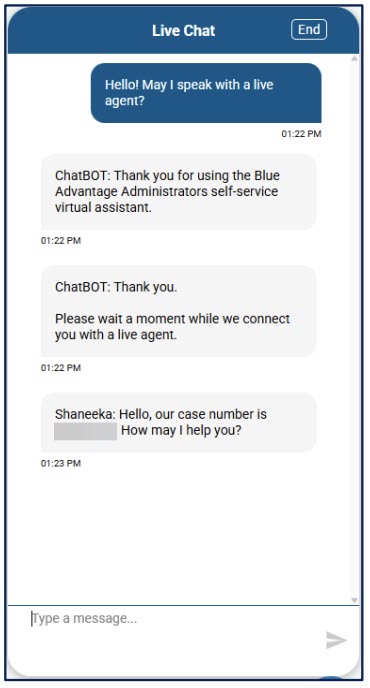
Another robot name that we like for its admirable clarity: Arkansas BCBS’s chatbot is named ChatBOT.
Organizations must be patient and take steps to overcome gen AI distrust
CI’s survey found that chat tools have become the preferred support method for many members, with 76% choosing chat over traditional alternatives like phone calls, message centers or site search. Members select chat tools primarily for convenience, citing faster service than calling or emailing (76%), easier access than navigating insurer websites independently (58%), and the ability to multitask while using the tool (52%). While members show a strong preference for human agents over virtual assistants (60% vs. 18%), the overall appeal of chat functionality demonstrates its effectiveness in meeting modern member expectations for accessible, efficient support. There is a large opportunity for firms that can build trust in their gen AI-powered chatbots.
Firms should design chat tools that maximize these convenience advantages. Universal findability, quick automated responses and multitasking-friendly make these chats easier to use. Aetna’s universally available chat icon ensures members can quickly access support from any page without hunting through menus or contact sections, supporting the multitasking capability that 52% of survey respondents value. The seamless transitions between virtual assistant and live chat within the same conversation window maintains this convenience.
UPMC’s Virtual Concierge does well in providing immediate access to information members would otherwise need to locate through site navigation or phone calls, with visual deductible breakdowns and in-chat ID cards. The tool’s comprehensive preset options spanning billing, coverage and care-related topics demonstrate how well-designed chat tools can serve as a faster alternative to traditional support methods.
Meanwhile, Florida Blue demonstrates speed advantages through Sunny’s 24/7 availability and swift responses to common inquiries like deductible breakdowns and ID card requests. Sunny displays both front and back ID card views directly within the chat interface, eliminating the need for members to navigate elsewhere on the site or wait for mailed cards. The pop-up window design supports multitasking by maintaining member access to other site functions during chat interactions.
Contact CI to learn more about how to access the full report and other Health Plan Monitor research. We also offer research solutions in Health System, Pharmacy, and Medicare.